

Is the freebie really free?
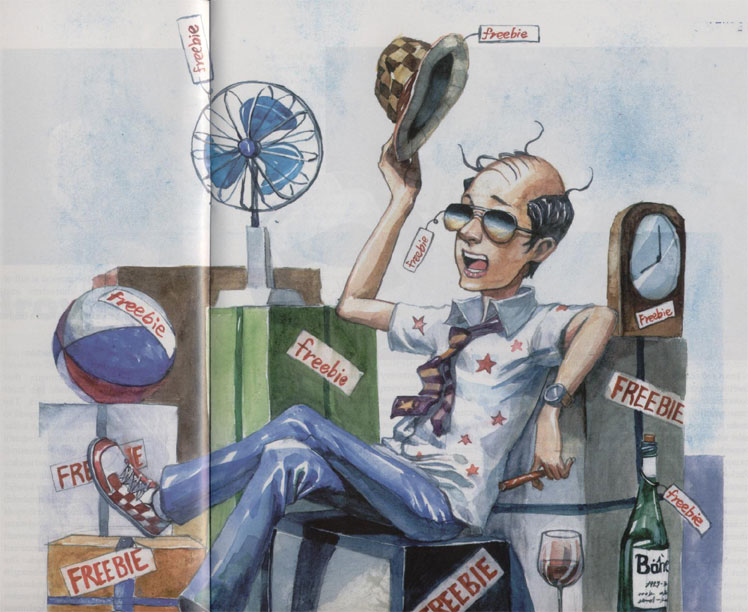 | ||
A flood of freebies
According to the balance sheet for the first half year, from January to July, about 120 freebie events per day were held in 2004. The total number for the year is projected to be almost 305,000. Furthermore, the value of freebies Koreans can take amount to ₩100,000,000,000 a year. Giving an addition, a free gift and a sample are the relative freebie events. They are the cases offering freebies to people irrespective of whether they are consumed or not. The preference for freebies has existed since long before. It became more intensified after the mass production of consumer goods was carried out. So to speak an interesting fact, the first freebie was a bull offered by Hwashin Department Store in 1936. As days go by, the quantity has increased and freebies have become more diversified. Especially, after the occurrence of economic stagnation, most companies began to hold the free gift events, and these events evolved into a great syndrome. Besides, there are many agencies of the application for premium, and these companies have enlarged little by little since 1999 and are now over 20. Many people who have joined the web sites are managed by an agency. The companies are also introduced by the TV programs and attract public attention. According to Kim Hyung-ju, a representative of a freebie application agency Wow Chance, university students who join this company are increasing, and they amount to 15,000 people, half of the whole membership.
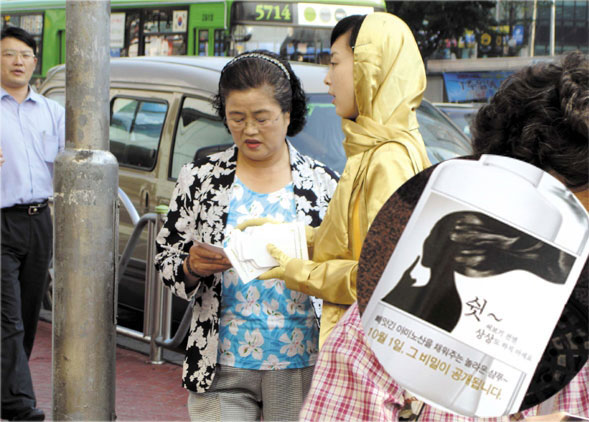 | ||
| ▲ A staff of a company is giving shampoo samples to passerby. | ||
Where is the free boom coming from?
Nobody dislikes "free", and the free syndrome in this society may seem to be natural. However, there are lots of different reasons that drew the free boom.
From the standpoint of the customer, it can be said that the syndrome comes from evasion of labor. To gain something, people should go through a process of labor, however, most people want to have goods without toil because they think that the labor is painful and difficult. That is, people wish to make a killing instead of making money by working throughout a lifetime.
In addition, the freebie boom is also affected by the cultural climate of Korea. Prof. Kim Wang-bae (Dept. of Sociology) explains that they cannot gain just compensation though work hard. Because Korean society has been developed compressively in time and space, the social transfer was severe. In the process of growing, for example, some people fell in with a piece of luck thanks to a rise in prices of land bought when the prices were low. At that time, many people might have felt comparative deprivation after seeing people who succeeded due to that accidental bonanza. Furthermore, they might think that they could also make a hit like others who already won success, so they were enthusiastic over freebie and bonanza. Prof. Kim said, "The freebie syndrome can be understood as one of the isms of windfall, and most people challenge freebie events continuously, because they believe in their achievement and are persuaded by our spiritual climate."
From the company viewpoint, the freebie market exists owing to the economic crisis. To accelerate a frozen consumption, companies began to make samples. Because the results of sales were not satisfactory, companies began to start an aggressive marketing campaign using freebies. Vance Packard, a marketing psychologist, mentioned an example of the power of freebie samples in his book The Hidden Persuader. A host of a supermarket in Indiana let guests taste freely various cheeses in front of his market, and owing to that he sold as much as 1,000 pounds of cheese. Considering the fact that he sold 300 pounds per day before, it explains the great power of freebie samples.
Lastly, psychiatry professors say that most Koreans, especially the young, are taking freebies all for granted because they have been overprotected by their parents since they were very young. Compared with the existing generation who experienced poverty in society, the young have grown up in richness. Therefore, they do not know that the price gained through pain and sweat of labor is justifiable, and they are excessively accustomed to receiving from others.
True or false
 | ||
| ▲ A mobile telecommunication company is holding a freebie event offering a digital camera as a prize. | ||
Freebie events are a help to the economy of customer and company; however, they also have bad effects. Although a freebie helps with the short-term extension of a company, it does not aid in the long-term, and it also needs too much expense for making samples. Besides, there are many people who are put to a bad use. For example, when a company offers freebies by drawing, some people who draw a losing number return the goods continuously. Their egoistic actions are very harmful to the economy of the company. Meanwhile, a lot of freebies also instigate impulsive and conspicuous consumption, and they make people waste their time and money. People who are exposed to the excessive freebie events also feel intense loathing. Again, freebies, which are carried for the conquest of recession, can have a reverse effect in that people grow too familiar with the low or no cost, and the depression can be maintained. According to the result of analysis about the sales of chilled or frozen food last winter, the weekly sales when a sampling event was held was as much as seven times higher than the week when the event was not offered. An officer of the department store said that holding the freebie event is inevitable because there is a sales difference of 30 ~ 40 percent between the periods. It shows how people become habituated to the freebie events.
Self-examination and marketing ethics
 | ||
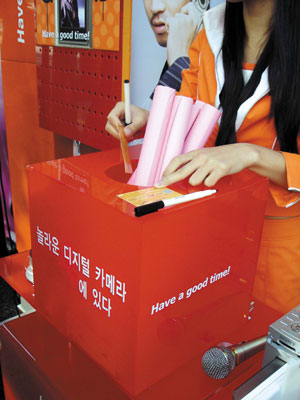
| ▲ An application box for a freebie event held by a department store | ||
Prof. Lee Moonkyu (Dept. of Business Admin.) emphasizes that people using freebies basically should adhere strictly to the marketing ethics. Companies can easy cheat customers if they want only the extension of the promotion, however, to play a trick is eventually an action degrading oneself by cheating and telling lies. To prevent failed results, the sellers should observe business ethics. In addition, a rule to control the companies from deluding customers continuously is also needed.
Customers should obey marketing ethics, too. There are people who make a frantic attempt to seek freebies. Some of them never even buy the product, but think that it is a matter of course to gain goods for free. These people also go against the commercial manner. That behavior may affect an economy to sustain recession.
Freebie, but there are no freebies
There are common sayings that say, "If you love free, you will become baldheaded," and "If it is free, people will drink even caustic soda." They show that the situation of the freebie preference was made long ago. Koreans generally have thought about giving and taking something for free, and the actions were considered as a kind of virtue. This feeling among of Koreans has continued, but the society has changed. Our current society emphasizes reasonable economic thinking, while it stirs up freebies. The situation gets worse because both company and customer pursue only their own profit. The freebie like that may be just a thing promoting a speculative spirit and giving vain thinking. Therefore, the company should give customers not only the economic profit, but also the essential gains and quality service. The customers should have rational thinking, too. It is quite natural to be affected by freebies; however, it may be a wise attitude to enjoy something at a reasonable level. A freebie syndrome should be helpful to both the sellers and the buyers. If company and customer utilize freebies well, all they may gain riches in this freebie heaven.
Photographed by Hong Hae-jin